Maths at Ages Three to Eight
This area is really enjoyable because it’s often practical. In many ways the teaching of Maths has changed considerably over the last 40 years. Firstly, counting in tens is emphasised early on; some processes are taught earlier and some later than in the past.
Here are some practical ideas to keep you going from ages 3 to 6. I then go into more detail for 6 to 8 year olds.
- It’s good to mention what month you are in when it changes and give some kind of the idea of length of a month.
- Fractions: half an apple, an orange. Later a quarter of an apple, an orange, a pizza.
- Help your child know which coins are which and eventually to add small amounts. When you go shopping ask your child to find some coins for some small item in your shopping. Then pay by card, if you do, for the other stuff.
- It’s useful to use the dice in games, so that in time, they begin to recognise the number configurations.
From about the age of 5 and a half, your child may be ready to:
- Look at a 100 square – a large poster or a smaller card with all the numbers arranged in tens to 100. This is used for counting and for recognising numbers. Seeing two-digit numbers will likely be new to them.
- Start looking at clocks and learning the o’clock time. Many people today use digital time so you might look at both. Whichever one, remember to talk about the time of day so the young child is aware of what times of day things are usually done.
- Eventually, show your child how much a loaf of bread or packet of biscuits weigh. The weight should be on the pack. Same with liquid. Then when they come to learn about grams and litres in school, the names will mean more to them.
These concepts and activities (such as those above and, for example, odd and even numbers) are taught in school, but I find that many children benefit from further explanation, real-life demonstration and repetition.
Years One and Two
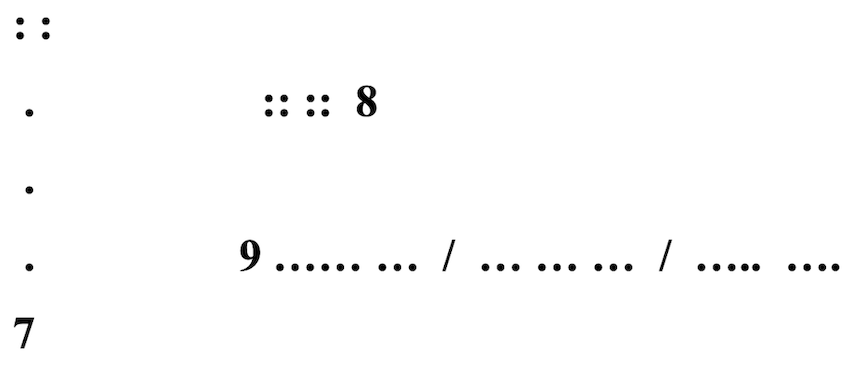
Some Maths teachers like to develop visual dice patterns for numbers beyond 6.
So, 7 is formed in a Y shape using 4 and 3, 8 using 4 and 4, 9 using 6 and a 3, or a 333 or using 5 and 4.
As I said counting in tens is emphasised first and then counting in 2s and 5s. Counting back at various stages is very useful – early on from 10, then from 20, later from numbers such as 40, 50, 70, 34, 67 and so on. No need to go back all the way to zero. This is very relevant for all ‘take away’ sums and often needs extra attention.
Work with the 100 square again: it can be used for counting in tens from any number, so 53 add ten is 63 and counting in ones. Learning to write numbers between 100 and 120 always benefits from a little attention.
Number Bonds
Understanding and knowing the number bonds to 10 well, is vital and is emphasised in school. I concentrate on these basic ones:
5 + 5, 9+1, 8+2, 7+3, 6+4.
It is also vital to really know and understand the key constituents of other one-digit numbers – 3,4,5,6,7,8 and 9. Later, these bonds can be used in more advanced work.
* see below
I find these bonds are vital and are quite sufficient to know:
- 3 = 2+1
- 4 = 2+2 and 3+1
- 5 = 3 +2 and 4 + 1
- 6 = 3 + 3 and 4 + 2
- 7 = 5 + 2 and 4 + 3
- 8 = 4 + 4 and 5 + 3 and 6 + 2
- 9 = 6 + 3 and 5 + 4 and 7 + 2
Adding Up
Basic addition of 1,2,3 and 4 to small numbers. Similar ‘take aways’ can come a little later.
If you have two different numbers to add, start with the larger one.
Adding numbers onto 10:
- practise 10 + 5 = 15. 10 + 8 = 18 and so on so that it becomes automatic.
- Then go for the logic of 9 + 5 is 10 +5 – 1.
- Likewise, 11 + 7 is 10 +7 + 1.
- Doubles are useful – 3+3. 4+4, and 5+5 are usually easily recalled
- but additional focus on 6+6, 7+7, 8+8 is very helpful.
- The concept of near doubles can be good too. If you need to add 8 and 7, add 7 + 7 and add one.
Adding 2digit numbers is initially dealt with in a lineal manner.
- 54 + 23 = 70 (7 tens) + 7(ones) = 77. I always underline the tens first, so as not to confuse the child.
- 45 + 35 = 70 (7 tens) + 10.
- Later 49 + 28 = 60 + 17 = 70 +7 = 77.
Using number bonds to ten. This will be useful all the way through and needs lots of practice.
26 + 4 is simple because you know 6 and 4 is 10, so 26 + 4 is the next multiple of 10 which is 30.
Likewise, 47 add 6 can be worked out by adding 3 to 47, and then 3 is added easily to 50. The system works well in subtraction too.
Multiplication is introduced in school early. I always use the term ‘groups of’.
So 3 x 3 is really 3 groups of 3 … … …
Groups of raisins can be used to make this real. Over the weeks, this kind game can be repeated many times.
With division, I always use the phrase, ‘divided by’ means ‘how many in?’ So ‘12 divided by 3’ means ‘how many 3s are there in 12?’ The child can then ‘count’ 3, 6, 9, 12. They have counted 4 times. Therefore, there are four 3s in 12.
These concepts and activities are useful from Reception to Years One, Two and Three.