
The Road to Reading
Learning to read is a process which lasts several years, approximately between the ages of about three and six. Even beyond that age, your child will need assistance to develop their skills, such as reading a wider vocabulary, reading longer words and progressing to longer books. (See video)
Continue to look at how your child holds the crayon. There are various stages of development in this area. I show children from the start the best way to hold the crayon or pencil for that stage of development. Please see the video for a full explanation.
Getting Started
Many people put up an alphabet chart with pictures in their home.
Continue to play ‘I Spy’.
Learning the sounds
This is the rough order in which I teach the sounds of the alphabet
- m, a, c, g, o, s, b, h, t, v, p, n, r, i, f, u, z, e, l and y. I teach the others later.
- m for mum
- a for apple
- c for cat
- g for goat
- o for orange
- s for sami snake, snail and sun
- b for bus, bed and bubbles
- h for hat
- t for teddy and toast
- v for van
- p for pen
- n for nose
- r for red, rain and rainbow
- i for ‘in’ and ‘igglepiggle’ (from In the Night Garden)
- f for fox
- u for up or umbrella
- z for zebra
- e for egg and elephant
- l for leaf and lion
- y for yo-yo
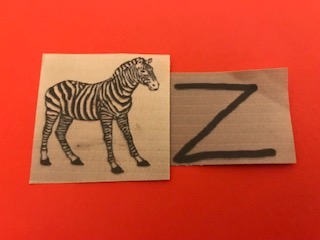
so common words with a picture which is easily recognisable and the initial sound is clear. Use your child’s name of course.
Later, w, j, d, k, qu, x
- w for wing
- j for jelly and jam
- d for dad and dog
- k for kite and key
- qu for queen
- x, well, as in box or just make the sound
I keep these sounds back as they are confusing for small children. Of course, use the first letter of your child’s name, whatever it is and also anything that your child especially likes. You’ll have to explain that big or ‘capital’ letters are used at the start of names.
Activities / Games
Only teach a few sounds at a time, review and after a while add one or two more.
Write 2 or 3 sounds on separate cards or pieces of paper. Find or draw a picture to go with it and put it on the back so, m – mum, a – apple, c – cat and so on.
Place the cards picture side up. Together name the pictures and then turn them over to show the letter.
You can then start with the letter cards turned up and say, ‘point to the m for mum’. The child is just pointing and doesn’t have to say anything and can turn the card over to check they have pointed correctly.
Have separate cards for letters and pictures and match them.
You can make letters with play-do.
There are also commercially made games involving letters and sounds – use what you want from them and leave parts out if you want to.
Have you heard of Letterland? It’s a marvellous little scheme with cards to teach the sounds of the alphabet. They use pictures and names such as the lovely ‘lamp lady’ to teach ‘l’. You can also trace how to form the letters as they are printed in felt on the cards. Perhaps only use this before your child starts school as not many schools use it nowadays and it may confuse them.
In a while, you can put three sounds together and make short three-letter words for example cat, mum, hat, hot, sun, big and so on. These are called CVC (Consonant Vowel Consonant) words. [Vowels are a,e,i,o,u; all the other letters are Consonants]
Introduce magnetic letters to make these simple 3 letter CVC words. Be careful with younger children as they may put the letters in their mouths.
All words must have a vowel. I do not mention this much at an early age as it would be too much for a young mind to take in.
They may like to make one or two words at first and then wait a little while before making a new one.
With any of these activities, always stop just before you think the child has had enough.
At the same time, continue to help with holding the pencil properly.